Reduce GHG Emission – Our Work to Combat Climate Change
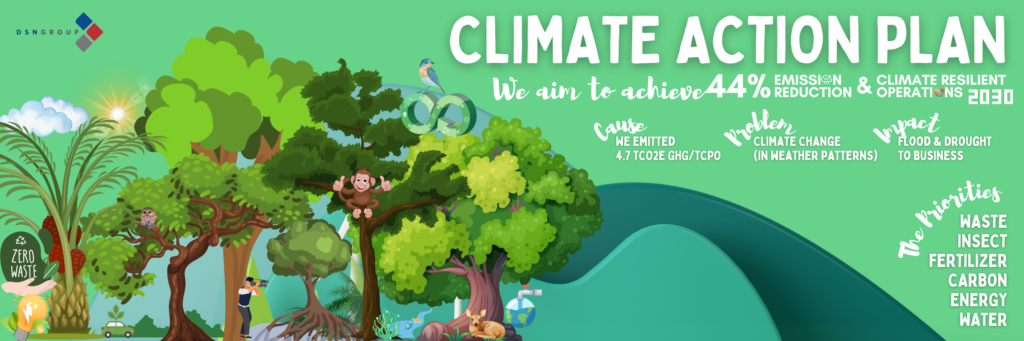
Our work on climate change is consistent with our Group Sustainability Policy to focus on three key areas: forests, climate and communities. As a company engaged in the agricultural industry, climate change is an existential threat for our industry and its is absolutely essential that the company prepare clear adaptation and mitigation measures. DSN Group has a deliberated and structured path towards their Net Zero aspirations with the aim to reduce emissions, adapt to climate change risks, and align itself to the efforts of the Government of Indonesia towards meeting its Nationally Determined Contribution (NDC) and the transition to a low carbon and climate resilient future.
DSNG’s Sustainability Policy is the main policy roadmap which integrates climate-related issues into business objectives and strategy. The policy applies to all our operations, suppliers and investments. The Group Sustainability Department of DSNG, through its Sustainability Governance Structure oversees, manages, and regulates environmental sustainability as well as climate risk issues together with the Business Units of the group. In addition, DSNG has implemented the Environmental & Social Management System (IFC-PS) to continuously identify our Climate Risks and Mitigation measures for the group. The individual business units management implement the necessary measures and monitor the climate risks at the operational level.
Under our Environmental and Social Management System (IFC-PS), we have identified key climate risks as well as mitigation measures to address them in our operations. We developed our initial Climate Risks Assessment (CRA) with Asia Biogas and ERM. Please see here our key outcomes of the Climate Risk Assessment study: DSNG’s Climate Approach, Methods, Impacts, Risks & Opportunities.
DSNG is committed under our Group Sustainability Policy (effective 8th July 2021) throughout our business units in the group, to the following :
1. Measuring our Carbon Footprint,
Since 2021, we have begun work on Greenhouse Gas (GHG) Emission Scoping with a notable company that are specialists in the field of emission reduction projects for businesses and organizations around the world. This work is essential to bring a detailed understanding of DSN Group’s current performance on GHG emissions and take stock of the future emission we will face. To provide an objective base from which to launch science-based approaches, that can mitigate or eliminate these emissions, which will eventually lead us to Net Zero.
2. Reducing our Carbon footprint
Earlier in 2021 we committed to actively reducing our ghg emissions by 29% in 2030, consistent with Indonesia’s commitment to reduce emissions against 2010 baseline. We also commited in our Palm Oil operations, where our largest carbon hotspot are, to reduce our greenhouse gas (GHG) emissions intensity by 16.4% by 2030 from our 2019 baseline.
With much diligence we worked on our Climate Action Plan over much of 2023, and we are pleased to revise our targets to reduce total (Scope 1, 2 & 3) GHG emissions 44% by 2030 from a 2019 baseline. This target takes into consideration our growth plans for the company and the existing technology available. We have not imputed any offsets nor natural biogenic sequestration in our targets, as we want to focus more on reducing our total emissions as a priority.
Therefore, in our Palm Oil operations, we are now committed to reducing our total absolute greenhouse gas (GHG) emissions by 44% by 2030 from our 2019 baseline. This target also reflects our commitment to reducing our total (Scope 1, 2 & 3) GHG intensity by 45% by 2030, compared to our 2019 baseline, as illustrated in the figure below.
For more details on our Climate Action Plan and Emission Reduction Targets by Business Unit, please download here.
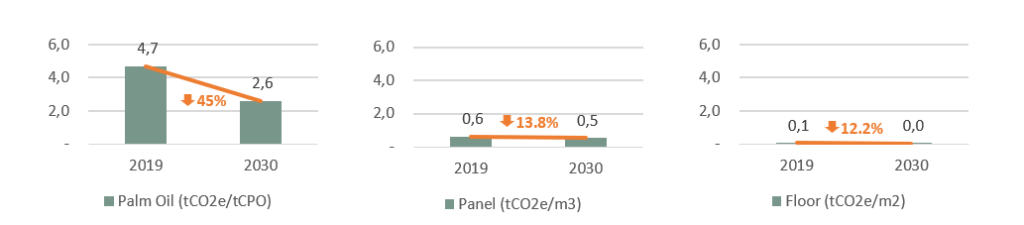
The said GHG emissions for both absolute and intensity have combined scopes 1, 2, and 3 emissions for both FLAG and Non-FLAG emissions. The calculation has excluded the offset from our biogenic removal.
In order to achieve the said commitment, we are consistently applying the NDPE policy throughout our supply chain, pursuing aggresively our energy independence from fossil fuels and innovating numerous ways to increase our efficiency while minimizing our carbon footprint. We realize that with emerging technologies and innovation we would be able to further reduce our emissions in the future and as such, we will review our targets GHG emissions reduction commitment from time to time.
Our GHG accounting and reporting follows the GHG Protocol Corporate Accounting and Reporting Standard, the Corporate Value Chain (Scope 3) Accounting and Reporting Standard, and the latest GHG Protocol Land Sector and Removals Standard (LSRS) v1.0. The LSRS requirements are incorporated into our FLAG emissions assessment to ensure comprehensive accounting of Land Use Change (LUC), Land Management (LM) production emissions, and net biogenic emissions.
These are the most widely used international accounting tools for government and business leaders to understand, quantify and manage GHG emissions. The standards were developed in partnership between the World Resources Institute and the World Business Council for Sustainable Development. The accounting methodology also follows guidelines from the Science based Targets Initiative on separation of FLAG and non-FLAG emissions.
The GHG accounting approach was based on the principles of the GHG Protocol:
- Relevance: an appropriate inventory boundary that reflects the GHG emissions of the company and serves the decision-making needs of users;
- Completeness: accounting includes all emission sources within the chosen inventory boundary. Any specific exclusion is disclosed and specified;
- Consistency: meaningful comparison of information over time and transparently documented changes to the data;
- Transparency: data inventory sufficiency and clarity, where relevant issues are addressed coherently; and
- Accuracy: minimize uncertainty and avoided systematic over- or under quantification of GHG emissions
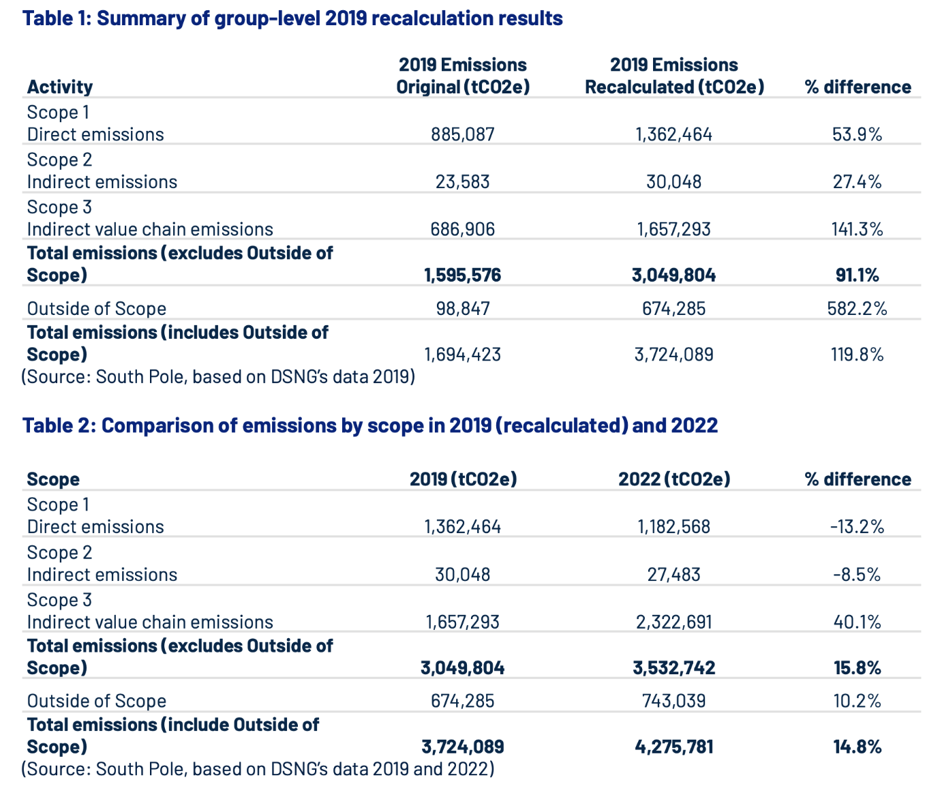
We established our GHG emissions baseline for FY2019 and continuously review both our progress and the latest developments in GHG accounting methodologies and standards. As part of our commitment to data quality and transparency, we also conduct external validation of our GHG inventory every three years. In mid-2023, we conducted another GHG inventory assessment covering our 2022 emissions. At the same time, in response to updates to the SBTi and GHG Protocol guidelines, we revised and updated our previously calculated 2019 baseline to ensure alignment with evolving best practices and internationally recognized methodologies.
Below is a brief summary of our GHG footprint for 2019 and 2022:
For the latest reporting year, we are pleased to present the results of our FY2025 GHG accounting, as shown in the figure below.
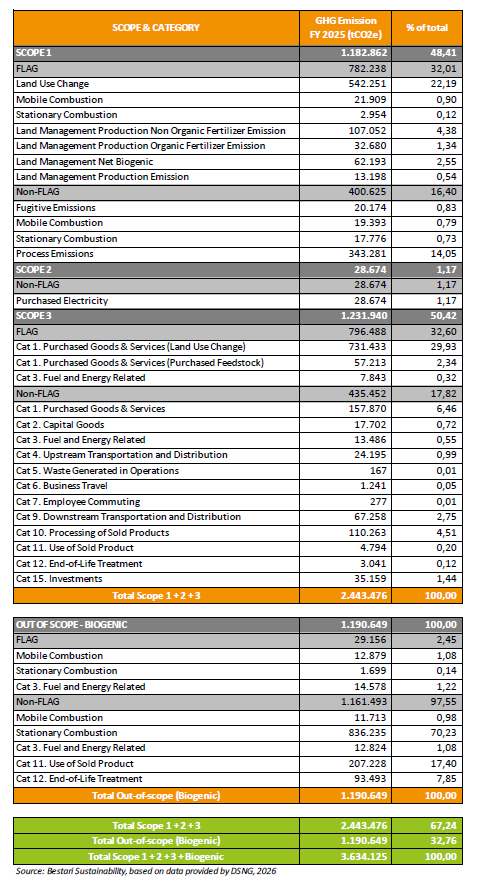
The GHG emissions inventory for FY2025 was prepared in accordance with the GHG Protocol and aligned with the relevant SBTi guidelines. The inventory covers Scope 1, Scope 2, and Scope 3 emissions across 100% of our Group’s business units, including Palm Oil, Wood Products, Renewable Energy, and Head Office.
FLAG emissions were quantified and reported separately from Non-FLAG emissions in accordance with the SBTi FLAG Guidance. In addition, biogenic CO₂ emissions from biomass combustion were reported separately from the Scopes, amounting to 1,190,649 tCO₂e. To maintain consistency with previous GHG inventories, the FY2025 inventory does not deduct or offset emissions through biogenic carbon removals or sequestration.
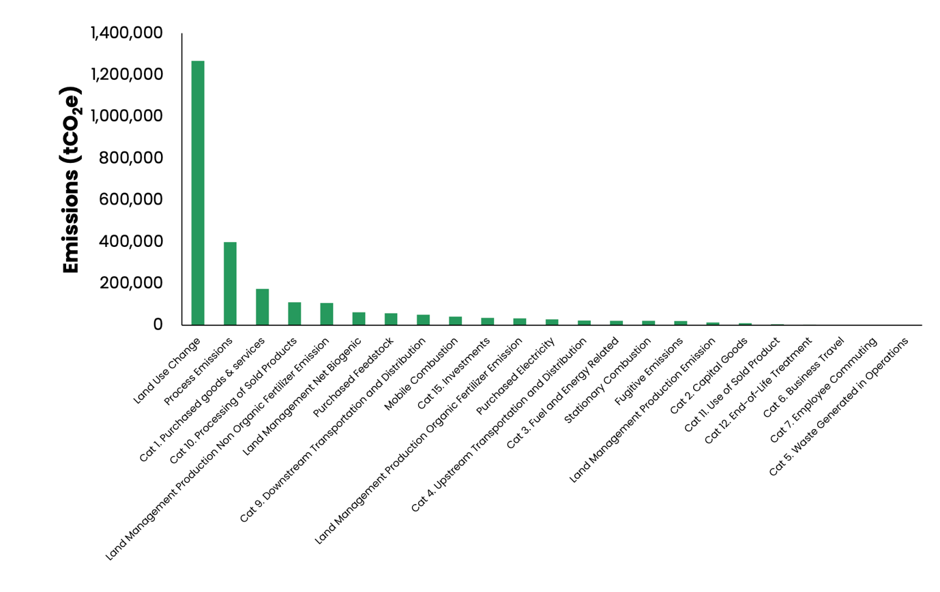
The inventory demonstrates that DSNG’s GHG footprint is strongly concentrated in land-related emissions and methane emissions from POME treatment. Land Use Change (LUC) was assessed using available Land Use Change Analysis (LUCA) records and spatial land-cover information, supported by remote-sensing datasets where required. Gross carbon stock losses resulting from identified land conversion were estimated using Indonesia’s 2022 Forest Reference Emission Level (FREL) carbon-stock data, covering relevant carbon pools, including aboveground biomass, belowground biomass, dead organic matter, and soil organic carbon. LUC emissions were allocated through linear amortisation over 25 years from the year of conversion.
Scope 3 FLAG emissions from LUC associated with purchased feedstock, together with Scope 1 LUC emissions, account for more than half of DSNG’s total reported GHG emissions. For the latest inventory, LUC emissions associated with Palm Oil supplier operations under Scope 3 were calculated in accordance with the GHG Protocol’s Land Sector and Removals Standard (LSRS) v1.0. These emissions amounted to approximately 731,432.6 tCO₂e, representing approximately 93% of emissions from the Purchased Goods and Services (PG&S) category related to FFB procurement.
The PG&S calculation applied the methodology and data provided in the World Resources Institute (WRI) and Quantis (2025), Statistical Land Use Change Emissions from Deforestation and Land Occupation for Crops. This reference provides a dedicated dataset and methodology for estimating the land-use-change component of crop and agricultural product footprints, particularly emissions associated with deforestation and land occupation.
For more details please see here: Key outcomes of the GHG Inventory Accounting study: DSNG’s Emission Disclosure FY2025.
Our efforts to reduce GHG emissions are reflected in the comparison of our GHG inventories, as presented in the figure below.
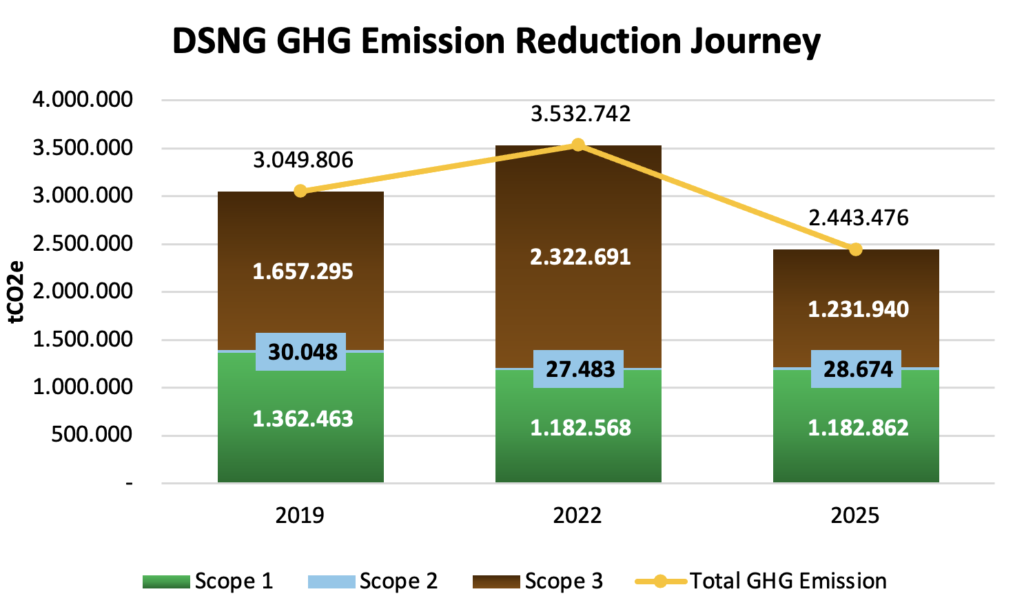
In 2025, we achieved a 20% reduction in our absolute GHG emissions compared with our 2019 baseline. Scope 1 contributed a 13% reduction, followed by Scope 2 at 5% and Scope 3 at 26%. This progress reflects the collective efforts of our internal teams and external stakeholders and our commitment to continuous improvement. We believe that the foundation of sustainable and consistent emissions reduction lies in operational efficiency. Through the operation of two methane capture and Bio-CNG plants across three of our mills, we have reduced emissions from anaerobic POME treatment while also reducing our reliance on fossil fuels.
Improvements in Oil Extraction Rate (OER) at our mills have also enabled us to increase CPO production while making more efficient use of high-quality FFB feedstock. At the same time, we recognize that emissions reduction across our value chain extends beyond our operations and FFB suppliers. Our CPO refinery customers have also demonstrated progress in reducing their own emissions, contributing to broader value-chain decarbonisation.
Looking toward 2030, we see greater opportunities to accelerate our emissions reduction efforts. This achievement also represents an opportunity for further improvement, including expanding methane capture capacity, evaluating emissions from upstream and downstream transportation, and engaging with external FFB suppliers to improve the availability and accuracy of supplier-specific direct land-use-change data.
As the Palm Oil Business Unit accounts for a substantial portion of our overall GHG emissions, we place particular emphasis on its emissions accounting and reduction efforts. In 2025, emissions from the Palm Oil Business Unit accounted for 92% of the Group’s total GHG emissions, amounting to 2,236,875 tCO₂e. This comprised 1,182,069 tCO₂e of Scope 1 emissions, 885 tCO₂e of Scope 2 emissions, and 1,053,921 tCO₂e of Scope 3 emissions. Overall, these emissions represent a 24% reduction compared with the 2019 baseline.
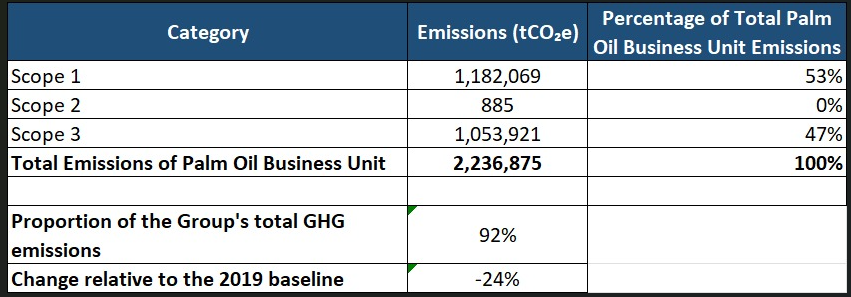
GHG emissions intensity also decreased from 4.8 to 3.4 tCO₂e per tonne of CPO produced. This improvement reflects the Company’s progress in reducing emissions while maintaining operational productivity and efficiency.
The 2025 emissions intensity was assessed against the 2019 baseline, providing a consistent basis for tracking progress toward the Company’s 2030 target of reducing GHG emissions intensity by 46%. The results demonstrate the contribution of operational-level emissions reduction initiatives and reinforce the Company’s commitment to continuously reducing its carbon footprint and supporting the transition toward lower-emission operations.
Please see here for details of our work to actively reduce emissions :
DSNG to develop solar power plant in Wood Product Segment
DSNG Commissioned First Bio-CNG Plant
Please also download our latest Sustainability Report to see our details and data on Climate Change Mitigation and GHG Emissions and Carbon Footprint.