Sustainability-related investments
DSN Group is committed to the principles of responsible investment. We will invest continually to reduce or mitigate our impact to the environment and bring positive impact to the community where we operate. We want to do more with less and in this journey we shall strive to report to our stakeholders our progress, especially with our efforts to increase the use of renewable energy and resources.
Renewable Energy
In the Palm Oil Business Unit, we utilize palm oil mill effluent (POME), palm kernel shell biomass waste, and palm kernel fiber to generate various renewable energy sources. Meanwhile, in the Wood Products Business Unit, we utilize solar power to diversify our operational electricity sources.
We successfully commenced operations of our first Bio-CNG plant in 2021. Then, in 2022, we began construction of a Methane Capture Plant and a second Bio-CNG plant at our oil palm plantation in Muara Wahau. By 2025, DSNG’s two Bio-CNG plants will utilize 432,118 m³ of POME to generate 9,766,800 kWh of electricity, which will be used in our factory operations, offices, and residential areas. In addition, 4,411,345 Nm³ of Bio-CNG was produced as fuel for generators and trucks, which is equivalent to a reduction in diesel consumption of 3.79 million liters and resulting in cost savings of up to 53.03 billion based on an average diesel price of Rp13,979 per liter. Throughout 2025, 57 Bio-CNG trucks have been converted resulting in a consumption of 164,510 Nm³ of Bio-CNG, which is equivalent to a diesel savings of 141,479 liters and an emission reduction of 379.16 tCO₂e.
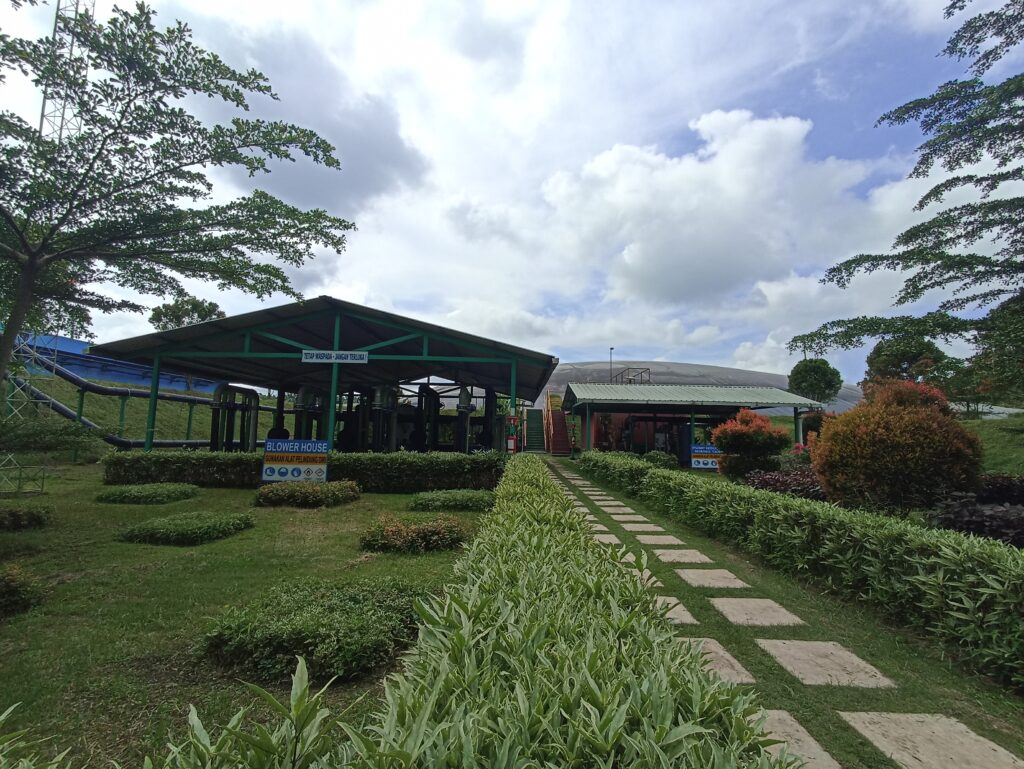
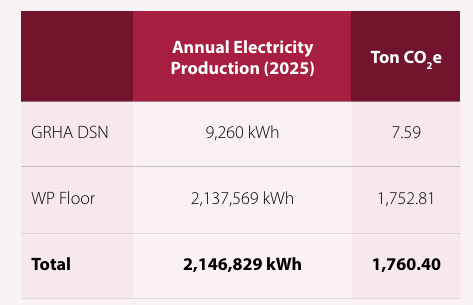
GRHA DSN integrates renewable energy into building operations through the use of Solar Power Plants (PLTS) installed at several points, including the Power House 2 reservoir pump system. This initiative contributes to reducing emissions, reducing dependence on fossil fuels, and strengthening the company’s energy efficiency efforts.
Strengthening Infrastructure to Support Community Mobility
DSN Group invests significant resources in roads and access to its plantations and mills. Improved roads and access result in various levels of efficiency, from improved fuel efficiency to ensuring quality fresh fruit bunches and raw materials, which in turn enables us to produce high-quality premium CPO. DSN Group also helps provide public infrastructure, including roads, bridges, public areas, and places of worship. For the transportation of FFB (Fresh Fruit Bunches), PK (Fruit Palm Oil), CPO (Crude Palm Oil), and PKO (Plant Based Palm Oil), as well as logistics, DSN Group builds access roads with safety principles in mind for both employees and the community.
Throughout 2025, DSNG implemented various infrastructure development and maintenance programs in its partner villages as part of the company’s commitment to improving the quality of life of the community, strengthening connectivity within its operational areas, and promoting sustainable village development. These activities were realized with a total infrastructure investment of IDR 6.67 billion. These activities included the maintenance and opening of village roads, road and drainage improvements, and support for the development of public and social facilities. The infrastructure program aims to improve public transportation access, particularly in supporting the smooth distribution of Fresh Fruit Bunches (FFB) to factories, opening access to new settlements, and facilitating logistics mobility and community social activities.
People
We consistently encourage our employees to commit to an OHS culture and conduct continuous evaluation, innovation, and improvement. To support understanding and build an OHS culture, the Company involves all employees in the implementation of the OHS Management System (SMK3) through several activities, allowing employees to directly participate, consult, and communicate with management. This communication also serves as a forum for employees to develop, implement, and evaluate OHS implementation.
In 2025, OHS training and socialization attracted 12,267 participants through 36 activities, covering occupational safety, 5R (Respiratory Safety), OHS signs, use of fire extinguishers (APAR) and personal protective equipment (PPE), pesticide management, fire emergency response, and understanding ISO, ISPO, and RSPO standards. A total of 493 participants received OHS certification throughout the year as part of workforce competency development. The Occupational Health Training Program was also implemented through various activities, including employee first aid training, maternal health education for TPA (TPA) mothers, pregnancy classes, tropical disease education, PHBS socialization, and Healthy Talk, with a total of 64,001 participants. Complete information regarding the training program and participants is available this link
Indirect Economic Impact
The Company is committed to promoting sustainable development in communities surrounding its operational areas by applying the principle of shared prosperity. This effort not only involves communities in the business supply chain but also ensures the sustainability and resilience of their livelihoods. Communities contribute as suppliers of raw materials, providers of transportation and construction services, and food supplies for employees and their families.
Throughout 2025, the Company implemented 15 economic empowerment initiatives involving women’s groups, youth, and local wisdom-based micro, small, and medium enterprises (MSMEs) around its palm oil concessions. These programs include business development in non-palm oil economic sectors, such as coffee, honey, fisheries, chicken farming, maintenance and repair services, environmental management, MSME development, and community-based arts and ecotourism groups, with an investment of IDR 812 million. By December 2025, these initiatives generated potential community income of IDR 329 million, reflecting the program’s contribution to increasing local economic activity through a Social Return on Investment (SROI)-based mentoring approach.
Replanting Investments Produce Future Profits
The company is committed to consistently renewing its resources in a timely and effective manner by replanting in accordance with best practices using the best oil palm seeds adapted to local land and climate conditions. In 2025, DSNG will continue its mechanical oil palm replanting program covering 2,249 hectares as part of its no-burn policy. The replanting program is carried out in stages to maintain and increase plantation productivity on mature or otherwise unoptimal trees. The replanting process includes providing seedlings, removing and shredding old oil palm trees, removing roots, and utilizing biomass debris as organic fertilizer.