Engaging Suppliers for a Sustainable, and Inclusive Palm Oil Industry
DSN’s approach to social inclusion integrates multiple dimensions to create a sustainable and inclusive palm oil and wood product business units. We strengthen our supply chain through training, empower smallholders with best practices, expand our network of local cooperatives, and provide comprehensive support for local farmers. Our commitment to these initiatives ensures a thriving, sustainable, and inclusive palm oil and wood product sector.
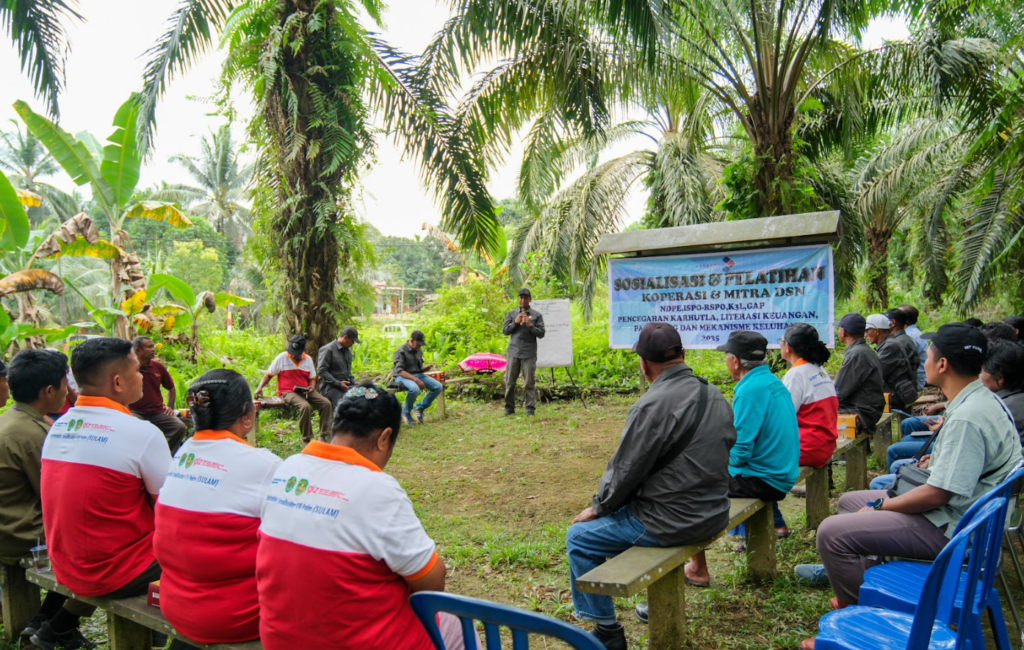
Strengthening Our Supply Chain through Training and Socialization Activities
To improve our suppliers’ understanding of the palm oil supply chain and to ensure compliance with ISPO & RSPO certification and NDPE policies, we conduct socialisation and training activities on ‘Supply Chain and Requirements’. These activities provide our suppliers, especially independent smallholders, with essential knowledge on best practices, minimising negative environmental and social impacts, and producing high quality and high yielding fruits. As of the end of 2025, the program had reached 3,365 Independent Smallholder Cooperative farmers (62%), 1,834 Agent farmers (34%), and 221 internal company participants (4%). These participants received guidance and training materials on sustainable plantation management, including NDPE and grievance mechanisms, occupational health and safety (OHS) topics, as well as dissemination of ISPO and RSPO standards, and oil palm agronomy through the Farmer Field School (Sekolah Lapang) program.
Cooperation between the company and the Partnership is carried out through a business entity in the form of a Cooperative. One of the activities carried out by the company to support plasma partnership farmers is through the RSPO certification programme, where until 2025, a total of 2,951 plasma partnership farmers have been successfully certified. This number is equivalent to 23.5% of the total plasma partnership farmers or 11.1% of the total of all farmers who send FFB to the company.
Empowering Independent Palm Oil Smallholders through Best Practices Training
We are committed to supporting independent and plasma smallholders, who play a crucial role as our suppliers. To this end, we have provided training on best practices for oil palm cultivation to empower them to increase productivity while maintaining sustainable agricultural practices.
Expanding our Network of Local Cooperatives and Agents
By the end of 2024, we have successfully partnered with External FFB receivers from 26 Self-Help Cooperatives and 52 Agents. In addition, we also collaborated with cooperatives to develop 65 plasma and saprodi plantations, which became our source of fresh fruit bunches (FFB). Today, in total we receive FFB from 143 units of plasma, saprodi and self-help plantation co-operatives across Kalimantan, further strengthening our commitment to the local community.
Supporting Local Farmers with Training and Sustainable Agriculture
Our support for local smallholders goes beyond business transactions. During 2025, we have provided training on good agricultural practices and sustainable farming to 5,420 Independent Smallholders across our plantations to ensure that they can continue to thrive and contribute to regional economic growth.