Food Security & Alternative Livelihoods
Food Security
Food security is an essential strategy to achieve the goal of Sustainable Development Goal (SDG) 2 of the UN. In the last five years, the policy direction of the Food Security Agency of Indonesia for strengthening food security in Indonesia was focused on three main areas – food availability, food accessibility and food utilization. We have a commitment to mitigate impact on food security, which applies to all our suppliers in our supply chain.
At DSN Group, we practice principles of FPIC, wherein affected local communities have the right to say ‘no’ to planned operations on their lands, during the information gathering stage and relevant consultations, negotiations up until an agreement is reached.
To ensure local food security, participatory discussions and mapping of the HCV and HCS assessments will reveal the actual conditions and land use planning of the community, including the choice of areas for food supply. Identification of land use is carried out by involving the local community, especially to identify paddy fields (rice), as well as other food production areas such as Tembawang areas in Kalimantan. The same commitment applies to all suppliers and supply chain
DSN Group is also consistent in helping farmers through the development of smallholder schemes (Plasma) and independent smallholders. The purpose of this scheme is to provide more opportunities for smallholder and help them to alleviate poverty, so that each family is more empowered in meeting primary needs, including food.
Alternative Livelihood
By providing alternative livelihoods, we create interventions that aim to reduce and mitigate activities that are potentially environmentally damaging. This is important, especially for farmers (independent smallholders) or communities who are in high risk areas related to deforestation and environmental degradation.
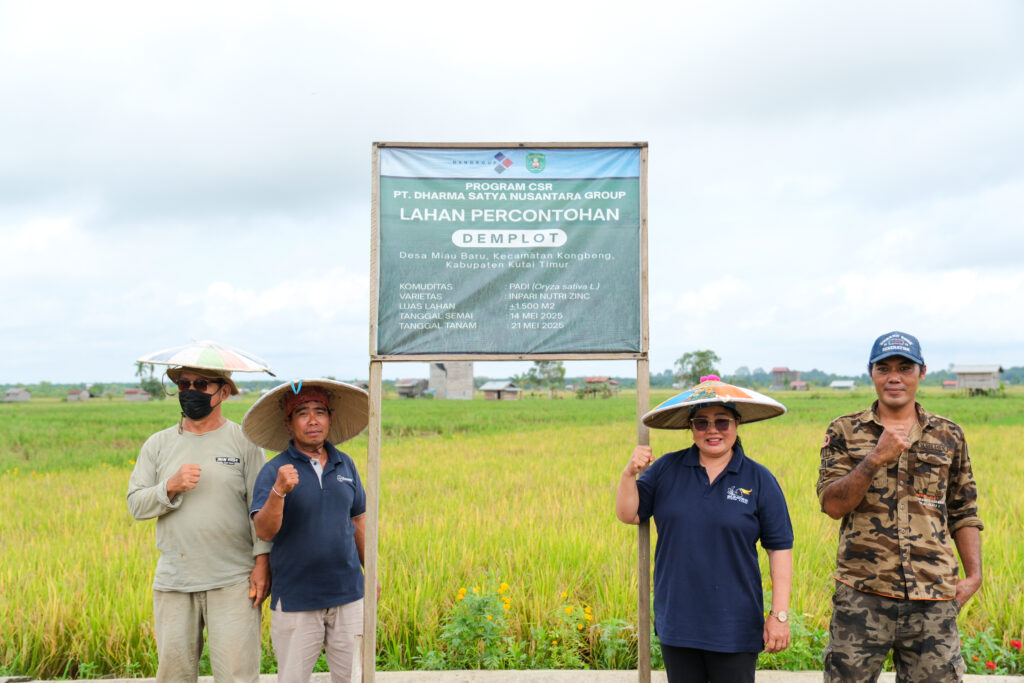
DSNG promotes community economic independence through the development of non-palm oil businesses and the strengthening of local institutions. The company supports various initiatives such as transportation services, Miau rice development, traditional crafts, and horticulture. This program is complemented by business mentoring, management training, and facilitation of economic access for community groups. A total of 2,058 beneficiaries of the non-palm oil economic program will be targeted by 2025.
For example, DSNG is collaborating with the Miau Baru Village-Owned Enterprise (BUMDes) to strengthen the local rice supply chain, reduce logistics costs, and reduce emissions. By 2025, 13% (351 tons) of the company’s rice needs will have been met by 300 local farmers, who will receive employment opportunities in the cultivation, milling, and distribution sectors. The DSN Group also fosters the development and management of elementary and junior high schools in collaboration with Sanata Dharma University. It provides teacher salaries and school transportation services and has developed informal education programs in residents’ homes.
DSNG conducted training in layer chicken farming for communities in East Kalimantan. Training covered all stages, from breeding, coop management, marketing, to production management. By the end of 2025, 12 participants in Muara Wahau produced 222 bundles of eggs (IDR 318,00 per bundle), generating a total revenue of IDR 12.37 million.